Why do most hair extensions turn yellow after textured?
Yellowing after textured is actually quite common.
But it’s not simply a “color issue” — it’s the result of how heat affects the hair structure during processing.
Cuticle impact
Heat can damage the cuticle. Once the surface is no longer smooth, light reflects differently, making the hair appear warmer or more yellow.
Pigment changes (especially on bleached hair)
Heat can also affect the pigments inside the hair, and this is more noticeable on bleached hair.
That’s why blonde shades are more likely to turn yellow, while natural or darker hair stays more stable.
Heat control
If the temperature is too high or the processing time is too long, it can cause slight oxidation, which further contributes to yellowing.
So not all hair extensions will turn yellow after textured.
So what makes SOONG. HAIR different?
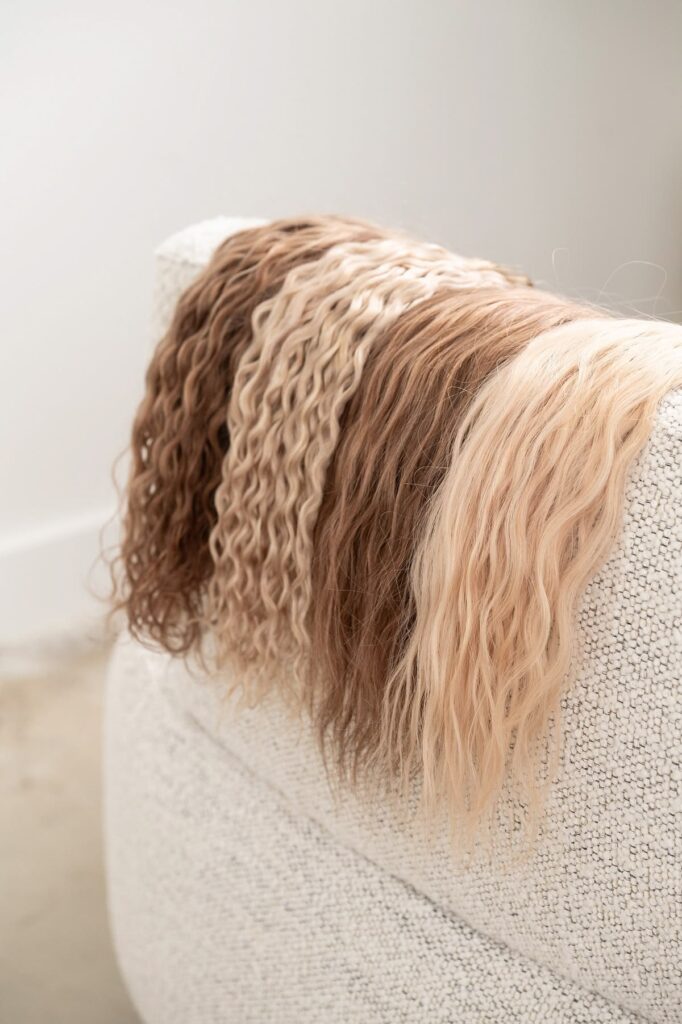
SOONG. HAIR EXTENSIONS textured collection — the hair color stays exactly the same after processing, with no yellowing at all.
It usually comes down to a few key things:
· High-quality raw hair
Our full cuticle hair is ethically sourced from women aged 16–26. The hair is naturally stronger, healthier, and more durable, so it holds up better during processing.
· Careful processing control
With proper heat control and timing, we’re able to reshape the hair (from straight to textured) while keeping the original color stable.
· Healthy, intact cuticle
After textured, the hair still feels smooth and soft, with a natural shine — no dryness, no frizz, no tangling. It just stays healthy.
· Real color stability
Even after high heat and reshaping, the color doesn’t shift or turn warm.
This is what no-yellowing textured hair looks like at SOONG. HAIR.And this is what we mean by high-end quality!